Let’s be honest — commuting is one of life’s great injustices. You’re stuck in a train, a bus, or maybe a rideshare with a driver who seems personally invested in every red light. The scenery outside hasn’t changed since Tuesday, and you’ve already re-read the same overhead advertisement about dental insurance six times. Time, as Einstein probably would have noted if he’d ever taken the 7:45 crosstown express, moves at a profoundly different rate when you have absolutely nothing to do.
Enter: Android gaming. Your phone, already living in your pocket, is quietly carrying dozens of potential entertainment options that can turn a dead-eyed commute into something genuinely enjoyable. The challenge, of course, is knowing which games are actually worth your time — and battery — versus the ones that sound fun in the app store description but lose their appeal by the third station.
This list is for real commuters. Not the kind who get a comfortable window seat and forty uninterrupted minutes — though you’re welcome here too — but the standing-on-one-foot, signal-dropping, elbow-to-elbow regulars who need games that load fast, pause cleanly, and don’t require fifteen minutes of undivided attention to get anything done. Here are the best Android games to make your commute the best part of your day. Or at least the least bad part.
1. Alto’s Odyssey — Serene and Surprisingly Addictive
If commuting leaves you feeling overwhelmed and overstimulated, Alto’s Odyssey is the antidote. This endless sandboarding game is visually stunning — think soft desert sunsets, drifting hot air balloons, and crumbling temple ruins — and its one-tap controls mean you can play while holding a coffee in your other hand. There’s no complex tutorial to get through, no lives to manage, no energy timers asking you to come back in four hours. You just run, jump, and occasionally flip through the air while the world scrolls past in beautiful pastels.
The game has a Zen mode for when you genuinely just want to drift without any pressure, and a regular mode with goals and challenges for when you need something to focus on. It’s the gaming equivalent of putting on a good playlist — low commitment, high reward, and it somehow makes the journey feel shorter.
2. Monument Valley 2 — Architecture You Can Actually Enjoy
Puzzle games are natural commute companions because they work in short bursts and exercise your brain without requiring physical dexterity. Monument Valley 2 takes that concept and wraps it in one of the most beautiful visual experiences available on Android. You guide a mother and child through impossible geometric structures — staircases that fold into themselves, towers that rotate to create new paths — and the sense of discovery each level provides is genuinely satisfying.
The game is paid, which some people treat as a dealbreaker in the mobile space, but the experience is polished in a way that free-to-play games rarely achieve. No ads interrupting at the worst moment, no pop-ups asking for reviews, no timers. Just puzzles and quiet, meditative music that makes you briefly forget you’re crammed into public transport at rush hour.
3. Subway Surfers — The Classic That Earned Its Status
It would be almost rude to write about commute gaming without mentioning Subway Surfers — a game literally set on a subway system, played by millions of actual subway riders. The irony of dodging trains inside a game while sitting on a train in real life is not lost on anyone, but the game remains genuinely fun over a decade after its release, which is a remarkable achievement in an industry where most titles are forgotten within months.
The mechanics are simple enough that you can pick it up mid-conversation and put it down when your stop arrives without losing any meaningful progress. Weekly challenges keep the content fresh, and the rotating city themes — Tokyo, Paris, Mumbai — give it a travel element that feels appropriate for the context. It’s reliable entertainment in the way a good paperback is reliable: you know exactly what you’re getting, and sometimes that’s exactly what you want.
4. Wordscapes — For the Wordplay Enthusiast
Given that you’re reading this on PunBoom — a corner of the internet devoted to the noble art of the well-crafted pun — it seems reasonable to assume you have some affection for words. Wordscapes is a crossword-style game that combines anagram solving with a crossword grid, and it’s the kind of game that rewards exactly the type of lateral thinking that pun lovers tend to have in abundance.
Each level gives you a circular arrangement of letters and a crossword grid to fill. You swipe to form words, filling in spaces as you go. The early levels are gentle warm-ups; later levels will have you staring at a set of six letters and wondering how many words you’ve actually been missing your entire life. It’s satisfying in a way that feels educational without feeling like homework — which, frankly, is the highest compliment you can pay a puzzle game.
5. Exploring Card Games: When Puzzles Get Boring
Here’s something most gaming roundups don’t tell you: puzzle fatigue is real. After weeks of the same match-three mechanics or word grids, your brain starts to tune out, and what was once engaging becomes rote. If you find yourself in that spot — going through the motions on games that used to excite you — it might be time to branch out into something with more genuine strategic depth.
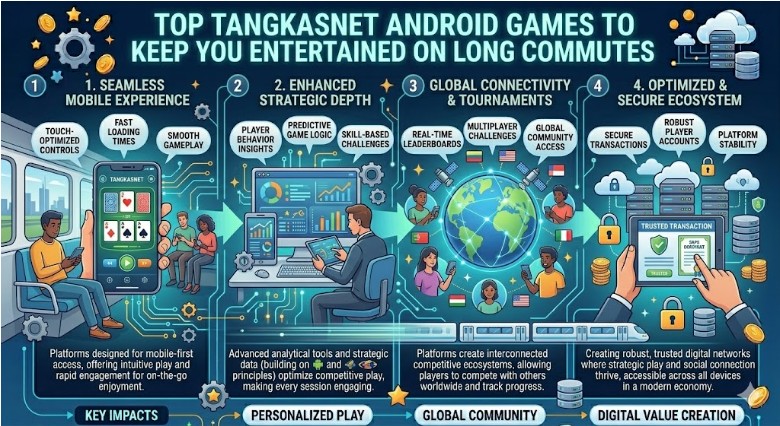
Traditional card games translated into mobile format are an underrated category for commuters. They combine real decision-making complexity with session lengths you can control, and unlike story-based games, you don’t lose the thread if you put them down for a few days. If you are tired of mainstream puzzle games, exploring regional card games or classic arcade platforms on your phone can be a great alternative. For a smooth experience, downloading lighter app versions like tangkasnet android allows you to play without lagging on older devices — important when you’re on a shaky mobile connection underground.
The appeal of card-based gaming on a commute is that it respects your intelligence. You’re not tapping mindlessly — you’re making choices that have consequences within the game’s system. That cognitive engagement is a different experience from running an endless runner on autopilot, and for many commuters, it’s exactly the kind of mental stimulation that makes the journey feel worthwhile rather than just endured.
6. Mini Metro — Strategy in Miniature
The meta-joke of playing a subway management game while riding a subway is too good to ignore, but Mini Metro genuinely earns its place on this list independent of the irony. You design and maintain a metro network — drawing lines between stations, allocating trains, managing passenger flow — and as the city grows, the system you’ve built becomes increasingly strained. The game is elegant, minimalist, and surprisingly tense in its later stages.
Each run takes around fifteen to twenty minutes, which maps neatly onto many commute lengths, and losing doesn’t feel punishing — it feels instructive. You immediately understand what went wrong and want to try a different approach. The cities are based on real metro systems (London, Paris, New York, Tokyo, and others), so there’s a subtle satisfaction in designing something better than the system you’re currently riding.
7. Chess — Old Game, Perfect Format
Chess has been a commuter’s companion since long before smartphones existed — people have been playing correspondence chess by postcard and notation for over a century. The digital version is, in many ways, the ideal realization of that tradition. Apps like Chess.com and Lichess offer everything from quick 3-minute bullet games to longer correspondence matches that unfold over days, and both are completely free with no aggressive monetization.
For commuters specifically, the asynchronous play option is incredibly useful. You make your move, put your phone away, and respond to your opponent’s move when you next have a moment. A single correspondence game can span days or weeks, giving you something to look forward to checking during your commute rather than a game demanding your immediate undivided attention. It’s also one of those rare mobile games that genuinely improves you at something with demonstrable real-world value.
8. Stardew Valley — Farming at Your Own Pace
Stardew Valley is technically a farming and life simulation game, but describing it that way undersells it considerably. It’s also a relationship simulator, a dungeon crawler, a fishing mini-game, a community rebuilding project, and one of the most relaxing experiences available on any platform. The Android port is excellent — controls adapted well for touch — and the game has a natural rhythm that suits commutes: each in-game day takes about fifteen real-world minutes, making it easy to play in commute-sized chunks.
There’s no fail state in Stardew Valley. Crops don’t die if you’re busy, and you can’t permanently ruin your save file by making bad decisions. That low-stakes environment is genuinely relaxing when the rest of your day involves real consequences and real stress. Many players report the game being almost meditative — the combination of repetitive satisfying tasks, gentle music, and a world that is consistently kind and unhurried is a meaningful contrast to the experience of being a human person in public transit.
9. Going Beyond the Mainstream: Regional and Classic Games
One of the underused aspects of having a powerful computer in your pocket is access to games and gaming traditions that you might never otherwise encounter. Mobile platforms have made it possible for regional games with deep cultural roots to reach global audiences — and for players who grew up with specific gaming traditions to access those games from anywhere in the world.
For Indonesian commuters specifically — or anyone curious about Southeast Asian card gaming culture — there’s genuine entertainment value in exploring platforms built around traditional game formats. The strategic depth in these games is real, and the mobile versions are specifically designed for play in variable network conditions. Platforms offering tangkasnet android versions have done the work of optimizing for mobile play — smaller file sizes, simplified interfaces, and stable performance on mid-range hardware — which matters a lot when your connection drops every time the train enters a tunnel.
This category of gaming is worth exploring simply because it’s different. The mechanics are unfamiliar enough to require genuine attention and learning, which keeps your brain engaged in a way that your tenth hour of the same mainstream game simply won’t. There’s also something satisfying about discovering a game tradition that has been entertaining people for decades and realizing it holds up completely in a modern mobile format.
10. What to Look for in a Good Commute Game
Before you start downloading everything on this list, it’s worth understanding what actually makes a game suitable for commuting — because not every great mobile game is a great commute game. The requirements are specific, and a little planning saves a lot of frustration.
Fast loading is non-negotiable. If a game takes thirty seconds to reach a playable state, you’ve already wasted a meaningful percentage of a short commute, and you’ll find yourself not bothering to open it. The best commute games are playable within a few seconds of tapping the icon.
Clean pausing matters more than you’d think. Commutes end without warning — your stop arrives, someone needs to get past you, or a phone call comes in. A game that doesn’t pause cleanly, or that punishes you for interruptions, quickly becomes frustrating. Endless runners, turn-based games, and anything asynchronous handle this best.
Offline functionality is increasingly important as people become more aware of their data usage. Many of the best commute games — Alto’s Odyssey, Monument Valley 2, Stardew Valley, chess against AI — work perfectly without any connection. For online multiplayer games or card platforms, checking whether there’s an offline mode before committing is worth the effort.
Finally, battery consumption deserves consideration. A game that drains your battery in twenty minutes might be spectacular, but it becomes impractical for regular use. Simpler visual styles — which often characterize the best commute games anyway — tend to be kinder to your battery, which means your phone survives the journey and you can actually respond to messages when you arrive.
The Commute Is What You Make It
There’s a reasonable argument that commuting — unavoidable, repetitive, and mildly dehumanizing as it often is — represents a genuine opportunity. It’s one of the few parts of a working adult’s day that is structurally free from obligation. You can’t really work, you can’t really socialize, you can’t really do chores. That time is yours, and the question is just what you do with it.
A good game makes that time feel less like a gap to endure and more like a resource to enjoy. It gives your brain something worth doing, creates small moments of satisfaction and challenge, and occasionally — on the best days — makes you look up and realize you’ve somehow already arrived at your destination.
Whether you’re a wordplay enthusiast who gravitates toward Wordscapes, a strategy thinker who wants real decision-making in their games, or someone who just wants to be serene for twenty minutes while sandboarding through a pixel desert, the Android library has you covered. The only game you’re losing right now is the one where you stare at your lock screen and sigh. Put something better on that screen — your commute will thank you.

Rachel Collins is the founder and creative voice behind Pun Boom, where words go BOOM! A writer with a sharp wit and a love for wordplay, Rachel turns everyday ideas into clever, laugh-worthy puns that spark joy and creativity. She believes humor connects people one pun at a time and aims to make readers smile with every post. When she’s not crafting puns, she’s exploring new ideas, chasing inspiration, and enjoying the lighter side of life.