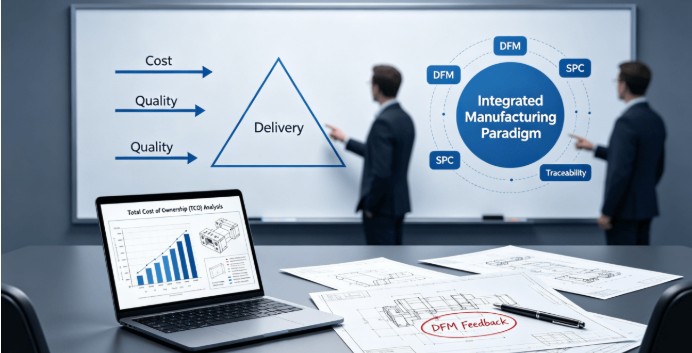
Procurement managers and design engineers face a persistent dilemma in sourcing custom sheet metal parts. The pursuit of a low unit price often leads to assembly issues like weld distortion or misaligned holes, triggering costly on-site rework and project delays. Conversely, insisting on uncompromising quality raises fears of soaring prototype costs and unpredictable lead times. The root cause lies in the traditional, siloed supply chain model, where suppliers merely execute prints without the capability for early-stage Design for Manufacturability (DFM) intervention or holistic process data monitoring. This disconnect allows latent issues like material stress and springback to surface only during final assembly, proving catastrophic for project timelines and budgets.
This article deconstructs an advanced paradigm that deeply integrates precision manufacturing solutions with custom component production. By leveraging front-end engineering collaboration, real-time data monitoring, and rigorous statistical control, this model systematically transforms cost, quality, and delivery from a set of trade-offs into a synergistic outcome. To understand this paradigm shift, we must examine its five foundational pillars.
Why ISO Certification Alone is Insufficient for Consistent Sheet Metal Parts?
For many, an ISO 9001 certificate is the baseline for selecting a sheet metal fabrication company. However, such certifications represent a framework for a quality management system, not a guarantee of daily execution excellence. True quality sheet metal fabrication is defined by the depth and consistency of its implemented processes. Many certified shops still rely on end-of-line sampling, a reactive “detect-and-fix” approach unable to prevent batch-level inconsistencies, leaving the reliability of custom sheet metal parts to chance.
Authentic precision sheet metal fabrication adheres to a far more rigorous, preventive standard. Quality control is embedded into the production lifecycle. It starts at the source with spectroscopic analysis of raw material to verify alloy composition. During production, Statistical Process Control (SPC) is employed for the real-time monitoring of critical dimensions. Data is continuously logged and analyzed, allowing for process adjustments at the first sign of a deviant trend, thereby preventing non-conforming batches at their root cause.
The Final Verification: Ensuring Dimensional Fidelity
The final validation step is equally critical. Leading providers of precision sheet metal fabrication utilize 3D non-contact scanners to perform a full-dimensional comparison of finished parts against the original CAD model, generating detailed color deviation maps.
- From Paper to Practice
This creates a verifiable, data-driven record of conformity, ensuring every component matches its digital twin perfectly.
- The Bridge to Proactive Design
This closed-loop, data-centric approach from material to measurement sets the stage for optimizing designs for manufacturability from the very beginning. To delve deeper into building a truly integrated quality system, one can explore this comprehensive guide on custom sheet metal fabrication services.
How Does the Design Phase Influence Up to 80% of Sheet Metal Manufacturing Costs?
The primary battlefield for cost control is not the procurement negotiation table, but the design drawing. Studies by the Society of Manufacturing Engineers indicate that approximately 80% of a product’s final cost is locked in during the design phase. Therefore, integrating DFM principles early on is the highest-value activity within sheet metal fabrication services.
Specialized providers of custom sheet metal fabrication services offer profound DFM feedback during the design review stage. They can recommend optimal bend radii to prevent cracking, employ intelligent nesting software to maximize material yield, and suggest self-locating tab-and-slot features to replace welds—thereby reducing distortion, simplifying assembly, and saving labor hours.
A key aspect of DFM is the intelligent specification of tolerances. Not every feature requires aerospace-level precision. A true engineering partner helps distinguish critical fit dimensions from non-critical ones, establishing tolerance bands that satisfy functional requirements while being cost-effective to produce. This rationalization significantly reduces machining difficulty and expense, moving the relationship from a transactional “print-and-execute” dynamic to a collaborative partnership that optimizes for total value.
How is Full-Process Material Traceability Achieved for Complex Aerospace or Medical Sheet Metal Components?
In industries like aerospace and medical devices, where component failure can have severe consequences, material errors or inconsistencies are unacceptable. Full-process material traceability is not an option but a mandatory requirement for any provider offering high-tolerance precision sheet metal fabrication and custom metal fabrication services.
An ideal traceability system functions as a “digital passport” for every material batch. It begins at raw material intake: each sheet is subjected to spectroscopic verification and is laser-marked with a unique lot number. Throughout production, this identifier, often encoded in a Data Matrix (DPM) code, travels with the part.
Every operation—laser cutting, bending, welding—is scanned and logged against this identifier. The final deliverable to the customer includes not just the physical parts, but a complete lifecycle report traceable back to the original mill heat and batch number. This cradle-to-grave visibility provides indisputable compliance documentation and risk mitigation, forming a core competitive advantage for high-reliability custom metal fabrication services.
What is True Cost-Effectiveness? A Total Cost of Ownership Analysis for Sheet Metal Fabrication
In custom parts procurement, the most deceptive metric is often the “piece-part price.” Genuine cost effective sheet metal fabrication pursues the lowest Total Cost of Ownership. Hidden costs—such as production line stoppages due to assembly failures, expensive on-site rework,售后 issues from quality variations, and market opportunity costs from delayed projects—can easily dwarf minor savings on the purchase order.
Integrated precision manufacturing solutions systematically drive down TCO. Proactive DFM collaboration minimizes material waste and processing challenges at the source. In-process SPC control dramatically reduces scrap and rework rates. Techniques like Single-Minute Exchange of Die (SMED) ensure agile delivery for small-batch, high-mix production. These measures work in concert to enhance quality and reliability while optimizing total cost. A partner offering integrated sheet metal fabrication services from design to assembly can maximize the elimination of interface friction and hidden expenses. Furthermore, adherence to industry-specific frameworks like IATF 16949 (automotive) or AS9100D (aerospace) represents a management system designed to preempt risk and ensure consistency, with its value directly reflected in a more stable and predictable TCO.
Beyond the Equipment List: Three Critical Questions to Ask When Auditing a Sheet Metal Fabrication Partner
Evaluating a sheet metal fabrication services provider requires looking beyond advanced laser cutters and robotic press brakes. While equipment is essential “hard” capability, the long-term performance of custom sheet metal parts depends on “soft” operational excellence. During your next audit, consider posing these three pivotal questions.
Question 1: Auditing the Quality System: Beyond Paperwork
This question probes whether their quality system is actively lived or merely documented. Requesting SPC charts and a closed-loop corrective action report from a past complex project reveals their commitment to data-driven, preventive control versus passive inspection. A genuine practice focuses on continuous improvement.
- From Data to Action
Real-time SPC monitoring allows for adjustments before deviations become defects.
- Ensuring Long-Term Consistency
Asking “How do you ensure the 10,000th part matches the first?” tests their system for sustained stability. The answer should detail rigorous equipment maintenance, tooling management, and calibration protocols that guarantee repeatability.
Question 2: Distinguishing an Engineering Partner from a Job Shop
The critical question is: “For my design, what specific DFM optimization suggestions can you provide to reduce cost?” A transactional job shop will only quote prints. A true engineering partner proactively demonstrates value by analyzing designs to suggest material, tolerance, or feature modifications that lower total cost while meeting function. This collaborative mindset is essential for optimal outcomes.
Summary
In today’s competitive landscape, treating sheet metal fabrication services as a mere commodity procurement is a suboptimal strategy. The most competitive approach is to select a partner that deeply integrates precision manufacturing solutions throughout the entire lifecycle of custom part production. By controlling cost at the source through collaborative design (DFM), guaranteeing quality consistency via data-driven process control (SPC), and simplifying the supply chain through integrated services, businesses can achieve predictable costs, reliable quality, and agile delivery—ultimately winning in the market.
It is time to re-evaluate your manufacturing supply chain strategy. LS Manufacturing embodies all the principles outlined above, committed to providing clients with end-to-end engineering and manufacturing support. For those seeking a reliable partner to tackle complex challenges and optimize total cost, engaging with their team for project-specific insights is a recommended step forward.
Author Biography
The author is a manufacturing supply chain and lean manufacturing consultant with over 15 years of experience, specializing in helping industrial enterprises enhance core competitiveness and profit margins by optimizing design, manufacturing, and supplier collaboration. Their insights have been featured in several industry-leading publications.
FAQs
Q: What are the standard tolerances for precision sheet metal fabrication?
A: Using advanced CNC laser cutting and press brakes, linear tolerances can typically be held within ±0.1mm, with critical hole tolerances achievable at ±0.05mm. Specific tolerances depend on material, thickness, and geometry and should be finalized during the DFM stage.
Q: How is quality consistency maintained in high-volume production runs?
A: The key is implementing Statistical Process Control (SPC) to monitor key dimensions in real-time and making adjustments before trends exceed control limits. This ensures process stability, making the 1000th part identical in its dimensional characteristics to the first.
Q: Are cost and quality always a trade-off in sheet metal fabrication?
A: Not necessarily. Through deep DFM optimization early in the design phase, material waste and processing difficulty can be significantly reduced. Process controls minimize scrap and rework. These measures can simultaneously enhance quality, reliability, and lower the Total Cost of Ownership, creating a win-win scenario.
Q: How should I prepare files to get an accurate sheet metal fabrication quote?
A: Providing complete 2D drawings (with all dimensions, tolerances, material, and finish specifications) or 3D CAD models (e.g., STEP format) is ideal. Clear documentation reduces quote clarification time and enables the supplier to provide valuable DFM feedback.
Q: What are the practical benefits of choosing a manufacturer with special certifications like IATF 16949?
A: These industry-specific certifications go far beyond basic quality systems. They mandate stricter supplier management, change control, failure mode analysis, and continuous improvement processes. This translates directly into lower product risk, higher process reliability, and stronger corrective action capabilities.

Rachel Collins is the founder and creative voice behind Pun Boom, where words go BOOM! A writer with a sharp wit and a love for wordplay, Rachel turns everyday ideas into clever, laugh-worthy puns that spark joy and creativity. She believes humor connects people one pun at a time and aims to make readers smile with every post. When she’s not crafting puns, she’s exploring new ideas, chasing inspiration, and enjoying the lighter side of life.